If you build or maintain hardscape north of the frost line, freeze-thaw isn’t an abstract risk.
It’s the reason you get called back to look at scaled driveways, rocking paver patios, and lifted walkway edges after a few hard winters.
The surface may look perfect at handover. A few seasons of freezing, thawing, and de-icing quietly test every weak link in the system.
This guide explains what “freeze-thaw rated” should mean, how to evaluate freeze-thaw-resistant pavers, how standards such as ASTM C936 and ASTM C1782 fit into product selection, and which material, base layer, drainage, and maintenance details matter most when choosing the best pavers for cold climates.
Why Freeze-Thaw Cycles Are So Hard on Paver Systems
Freeze-thaw cycles damage paver systems when moisture penetrates vulnerable areas, freezes, expands, thaws, and repeats. The resulting stresses can affect both the paving units and the structure beneath them, especially in cold climates with frequent snow and frost.
That distinction matters.
Durable concrete pavers, or even natural stone pavers like granite or bluestone, can still move when installed over a wet, frost-susceptible base. Likewise, an excellent base that includes proper drainage cannot indefinitely compensate for paving units that are poorly suited to the exposure.
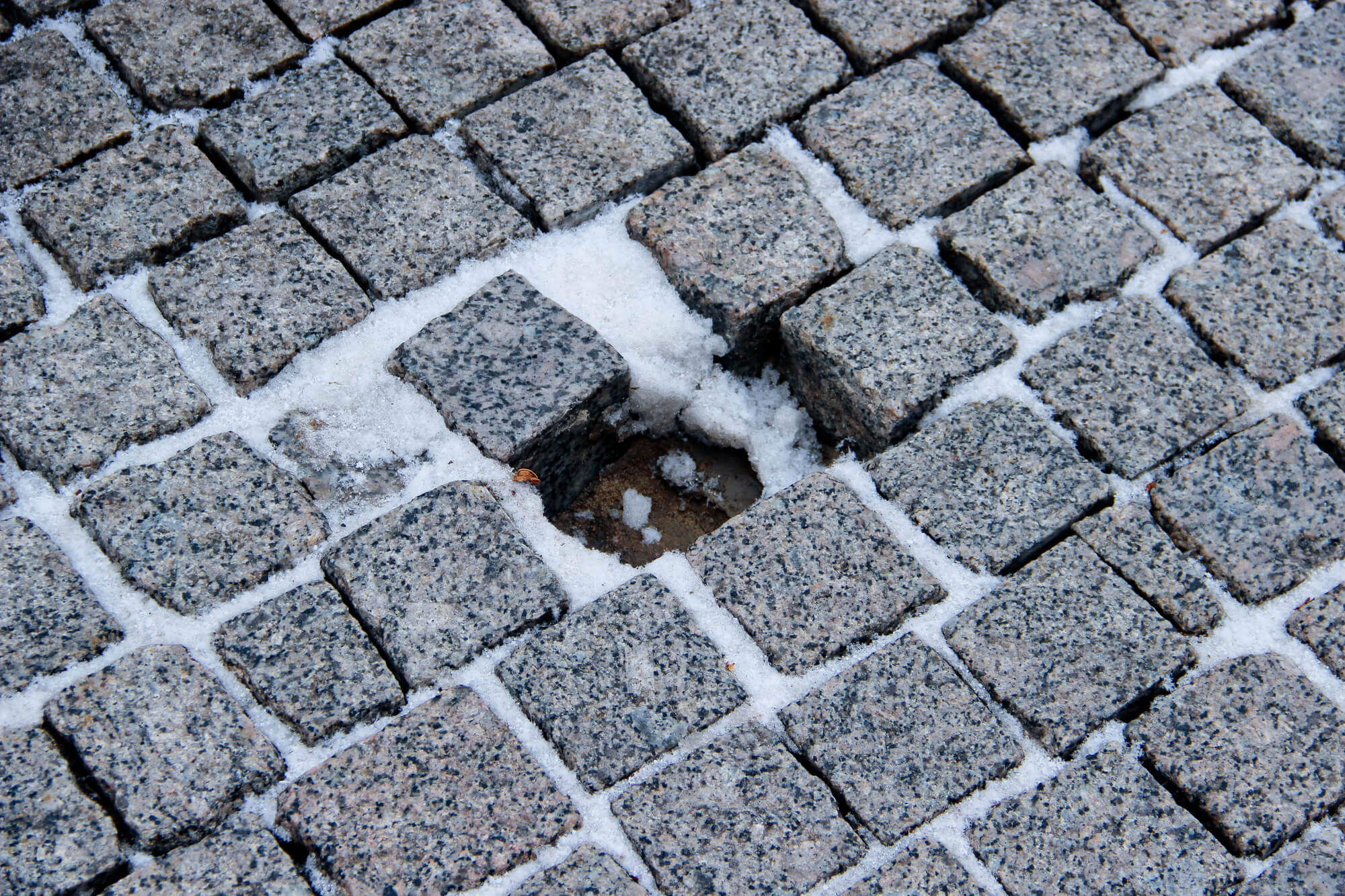
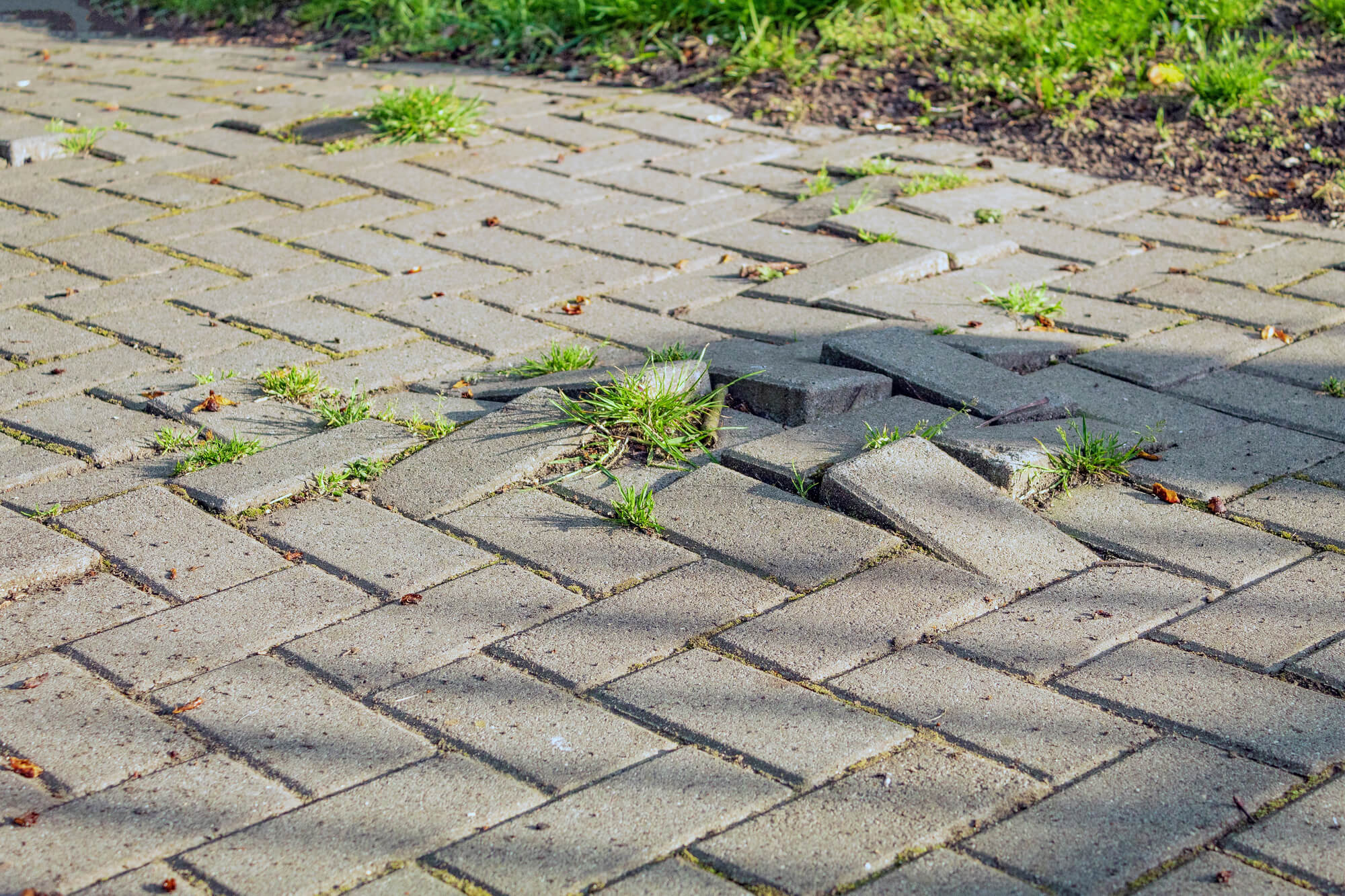
In systems with inadequate freeze-thaw resistance, damage commonly appears during winter as:
- surface scaling or flaking on patio or walkway surfaces;
- spalled edges and corners of the concrete pavers;
- rocking or uneven units due to frost heave;
- opened or deteriorated joints, which may need repair;
- differential heave affecting outdoor spaces;
- loss of interlock, especially in brick paver installations; and
- movement around curbs, steps, slabs, and other transitions.
Performance in cold climates, therefore, needs to be treated as a system requirement, encompassing the paver surfaces, base layers, drainage system, and installation methods.
The goal is to reduce the amount of damaging water entering and remaining within the system, while specifying units and materials, whether they are clay, porcelain, or concrete pavers, capable of handling remaining exposure. Proper maintenance, such as sealing and addressing soil conditions, further enhances durability and minimizes freeze-thaw damage.
What Does “Freeze-Thaw Resistance” Really Mean?
A concrete paver should not be considered suitable for severe freeze-thaw exposure simply because a brochure describes it as “all-weather,” “frost resistant,” or “winter ready.”
A defensible specification should connect durability claims to recognized standards, current technical documentation, and the actual product being installed.
When seeking freeze-thaw resistant pavers, consider the following:
- Applicable Product Standard: Ensure the paver meets specific standards for freeze-thaw cycles.
- Compressive Strength and Water Absorption: Look for documented mechanical properties and absorption rates to assess durability and minimize frost heave.
- Freeze-Thaw and Scaling Requirements: Verify that pavers meet relevant requirements to withstand exposure.
- Test Methods and Exposure Conditions: Understand how the product performs under expected winter conditions, including the use of de-icing salts.
- Product-Specific Technical Data: Confirm that test results apply to the specific thickness, finish, and paver being installed.
Three Key Questions for Paver Suppliers
To ensure you select the best freeze-thaw resistant pavers, ask the supplier these questions:
- Which standards and test methods apply to this exact product?
- Does the available data represent the current product being supplied?
- Does the testing reflect expected winter exposure?
Having clear answers and supporting documentation aids in choosing the right durable materials for your outdoor paver surfaces, ensuring long-term cost-effectiveness and minimal repair needs.
Whether opting for concrete pavers, porcelain pavers, natural stone, or other types, prioritize pavers with proven freeze-thaw resistance for a lasting installation.
Material Properties That Drive Freeze-Thaw Durability in Pavers
Freeze-thaw resistance for pavers is crucial to ensure a lasting installation, particularly in cold climates. The key is managing water absorption and understanding how materials cope with freeze-thaw cycles.
H3: Key Characteristics for Durability
Freeze-thaw durability in pavers relies on several critical factors:
- Strength: Pavers, including concrete pavers and porcelain pavers, require sufficient compressive strength to withstand traffic, whether for driveways, walkways, pool decks, or patio installations.
- Absorption and Permeability: Reducing water absorption and ensuring effective drainage are vital to minimizing moisture retention. High water absorption can lead to freeze-thaw damage.
- Manufacturing Consistency: Consistent manufacturing processes ensure that the pavers exhibit uniform resilience against cracking and frost heave across various batches. This consideration is crucial for the longevity of concrete pavers.
Evaluating Beyond a Single Strength Metric
While high compressive strength is important, effective frost resistance in pavers encompasses:
- strength;
- absorption rate;
- freeze-thaw cycles performance;
- surface characteristics to prevent slips and enhance safety;
- high-quality aggregates and joint materials;
- appropriate drainage base preparation;
- suitability for intended use across outdoor spaces affected by freeze-thaw climates.
Evaluating these factors together provides a better understanding of a paver’s ability to resist freeze-thaw cycles than a single strength figure.
The Role of Surface Technologies
Technology in paver production, such as surface treatments, assists in enhancing longevity and appearance. Still, these technologies do not replace the need for appropriate paver selection, proper base preparation, and thorough maintenance.
Rochester Concrete Products, for example, documents its Chroma Coloring System for color consistency and durability and its Chroma Shield manufacturing process for resistance to fading and the effects of de-icing salt and acid rain, along with added protection against staining and spalling.
An integrated approach involves using premium materials like porcelain pavers for elegance and durability, along with essential procedures such as compacting the base layers and ensuring proper drainage. This holistic strategy is essential to counteract the impacts of frost and ensure the durability of outdoor surfaces over time.
This systematic approach ensures that outdoor pavers effectively endure the stresses of cold climates, reducing the likelihood of spalling, cracks, and costly repairs, while maintaining their aesthetic appeal and slip resistance in various environmental conditions.
How to Read Freeze-Thaw Standards and Test Results
Laboratory testing gives contractors, designers, and specifiers a repeatable way to evaluate material performance before years of real-world exposure occur.
When reviewing technical documentation, concentrate on the relationship between the test, exposure, product, and result.
Look for:
- the named standard or test method;
- the number and type of exposure cycles, where applicable;
- whether water or a saline/de-icing environment was involved;
- measured deterioration or mass loss where reported;
- applicable acceptance criteria;
- sample identification; and
- The date and relevance of the test to the currently supplied product.
When more detailed results are available, don’t stop at a simple “pass.” Cycle count, exposure medium, measured deterioration, mass loss, and the product actually tested can give you a much clearer picture of what that result means for the project in front of you.
What Does ASTM C1782 Say About Freeze-Thaw Performance?
ASTM C1782/C1782M is the specification for segmental concrete paving slabs. Among its physical-property requirements, the standard addresses resistance to freezing and thawing.
While it’s tempting to call a paver product “ASTM C1782 freeze thaw certified” or something similar, the truth is that it should not be treated as a blanket freeze-thaw standard for every product commonly called a “paver,” even if it is relevant for specifying segmental concrete paving slabs within its scope for cold-climate applications.
Product classification matters.
Segmental concrete paving slabs within the scope of ASTM C1782/C1782M are different from solid concrete interlocking paving units, which are covered by ASTM C936/C936M.
For solid concrete interlocking paving units, ASTM C1645 is a test method used to evaluate resistance to freezing and thawing in water or saline solution.
That distinction is more than terminology. A larger-format slab, an interlocking concrete paver, a permeable unit, and a porcelain-surfaced system can look similar in a finished project while falling under different product requirements, test methods, or installation criteria.
The practical rule is straightforward:
- Identify the product type first, then verify the ASTM specification and freeze-thaw requirements that apply to that exact unit.
When reviewing an RCP product for a cold-climate project, use the current product-specific technical documentation to confirm the applicable standard, intended application, and relevant performance requirements rather than assuming one ASTM designation covers every paver or slab.
A Simple Submittal-Review Process
Use the same sequence on every project:
- Identify the standard: Determine what specification or test method the manufacturer is claiming compliance with.
- Match the exposure: Determine whether that standard and test are appropriate for the project’s climate, traffic, and de-icing environment.
- Match the product: Verify that the test data applies to the unit being proposed rather than a different thickness, finish, or product family.
- Examine the result: Look beyond a simple “pass” statement when more detailed results are available.
- Check currency: If the product, manufacturing plant, formulation, or process has changed substantially, determine whether the available documentation still represents current production.
This creates a repeatable review procedure instead of making every submittal a new judgment call.
What Are the Best Pavers for Cold Climates?
There is no universally “best” cold-climate paver independent of application. The best pavers for cold climates are products whose documented material performance, intended application, drainage system, installation requirements, and expected maintenance match the actual winter exposure of the project.
A sheltered residential patio, heavily salted driveway, primary pedestrian entrance, commercial plaza, and permeable pavement may experience the same winter but very different loading, drainage, maintenance, and safety demands.
That means the specification should begin with use and exposure.
| Application | Primary winter concerns | Specification focus |
| Steep driveway | Vehicles, braking, plowing, concentrated de-icer | Vehicular suitability, interlock, documented durability, drainage |
| Residential driveway | Vehicle loads, snow removal, de-icers | Appropriate thickness, strength, absorption, and interlock |
| Primary walkway | Pedestrians, shoveling, ice, accessibility | Surface texture, evenness, drainage, stable joints |
| Patio | Freeze-thaw, snow accumulation, furniture | Durability, drainage, and an appropriate pedestrian unit |
| Permeable pavement | Infiltration, sediment, freeze-thaw | Complete permeable system, open-graded base, drainage, and maintenance |
Within Rochester’s current collection, families such as Barrington, Minnetonka, Reno, Serano, Tahoe, Windom, and Holland give contractors options across different formats and design needs. The right starting point is still the documented application, not the product name or appearance alone.
These are specification priorities rather than universal engineering requirements. Exact pavement sections should follow applicable codes, local conditions, manufacturer guidance, and project engineering.
How Climate, De-Icers, Traffic, and Accessibility Change the Spec
Two projects using the same paver can require different specifications because their exposure conditions are different. Before finalizing the unit and pavement section, answer four questions.
1. How Severe Is the Local Freeze-Thaw Exposure?
Temperature alone does not tell the whole story. A location repeatedly moving above and below freezing while pavement remains wet may create a different exposure than a colder location where materials remain frozen for long periods.
Local frost conditions, soil characteristics, precipitation, drainage, and seasonal temperature patterns all belong in the decision.
2. How Will De-Icers Be Used?
A sheltered patio receiving little chemical treatment is not exposed like a sloped driveway or commercial entrance receiving repeated winter applications.
The expected maintenance regime should therefore be part of product and system selection.
3. What Loads Will the Pavement Carry?
Pedestrians, passenger vehicles, service vehicles, snow-removal equipment, turning loads, and occasional heavy equipment impose different demands.
Do not let an aesthetically similar unit lead you into treating every application as structurally equivalent.
4. What Accessibility and Surface-Performance Requirements Apply?
Walkways and entrances need more than material durability. Consider:
- surface evenness;
- transitions;
- slopes;
- surface texture;
- mobility-device movement;
- drainage; and
- applicable accessibility requirements.
The best winter pavement is not simply one that survives freezing. It also needs to remain functional for the people using it.
Base and Drainage Details That Protect Pavers in Harsh Winters
Even a highly durable paver can perform poorly over a saturated, unstable, or frost-susceptible foundation.
In cold climates, base and drainage design determine how much winter movement a new paver patio or driveway system must tolerate.
A resilient paver system generally requires:
- an appropriate non-frost-susceptible aggregate base;
- adequate depth for site conditions and loading;
- consistent compaction;
- appropriate separation where required;
- positive surface drainage; and
- a defined path for subsurface water to leave the pavement structure.
Cold-Climate Base Checklist
Before paving begins, verify:
- Design depth comes from local conditions: Consider frost conditions, soils, loading, codes, and engineering rather than relying on a universal depth rule for base preparation.
- Base material is appropriate: Use materials and gradations suitable for the pavement system and environment.
- Compaction is controlled: Weak or inconsistent areas can become future movement points.
- Surface water has somewhere to go: Provide suitable slopes and avoid creating unnecessary low points where water runoff can stall and pool.
- Subsurface water has an exit where necessary: Drainage details should prevent prolonged saturation.
- Downspouts are accounted for: Do not routinely discharge concentrated roof water onto vulnerable pavement areas.
- Snow-storage locations are considered: Repeated meltwater from snow piles can keep one area saturated throughout winter.
A paver cannot compensate for a foundation that repeatedly fills with water and moves.
Jointing, Transitions, and Winter Operations Matter Too
Cold-climate durability does not stop once the paving stones or bricks have been installed. Joint materials, edge restraints, transitions, utilities, and snow and ice removal practices can influence how well the pavement stays aligned and serviceable.
Jointing
Jointing systems need to match the pavement design. Depending on the application, that might involve conventional joint sand, polymeric sand, or open-graded aggregate in permeable installations.
Whatever system is selected, proper installation, joint width, and ongoing condition matter because deteriorated or contaminated joints can affect interlock, drainage, and surface stability.
Transitions
Pay particular attention to where segmental pavement meets:
- garage slabs;
- concrete walks;
- curbs;
- steps;
- utility structures;
- drains; and
- other fixed elements.
These are common locations for movement to become visible because adjacent systems may respond differently to frost and loading.
Winter Operations
Discuss maintenance before the first snowstorm.
Consider:
- snowplow equipment;
- snow-storage areas;
- de-icer practices;
- drainage paths;
- pavement edges and transitions; and
- inspection after severe winter events.
Winter maintenance should be treated as part of the pavement lifecycle rather than something entirely separate from design.
Common Freeze-Thaw Failures and What They Tell You
Winter distress is often diagnostic. Instead of immediately assuming a failed paver, use the pattern of damage to determine where to investigate first.
Surface Scaling or Flaking
Possible investigation points include:
- surface condition;
- product suitability;
- saturation;
- de-icer exposure;
- drainage;
- snow-storage patterns; and
- relevant product documentation.
If deterioration appears primarily in one shaded or heavily salted band, the location itself may be telling you something important.
Spalled Edges or Corners
Investigate:
- loading;
- joint support;
- edge conditions;
- transitions;
- product suitability; and
- whether the pavement section matches the actual use.
Rocking Units, Lippage, or Widespread Movement
Look beneath the surface first. Potential causes include:
- frost-susceptible subgrade;
- inadequate or inconsistent base;
- drainage problems;
- poor compaction;
- deteriorated joints; and
- seasonal movement around fixed transitions.
Replacing individual pavers without identifying the underlying mechanism can leave the real problem untouched.
Think of failure patterns as evidence. They help narrow the investigation before money is spent treating symptoms.
How Different Paver Types Behave in Cold Climates
Different paving materials solve different design problems, and their winter performance depends on both material characteristics and the system supporting them.
Dry-Cast Concrete Interlocking Pavers
Interlocking concrete pavers can be well-suited to driveways, walkways, patios, and other cold-climate applications when the selected product and pavement section are appropriate for the load and exposure.
Their segmental nature also allows individual units to be serviced when necessary.
Wet-Cast Slabs and Architectural Units
These can provide natural-stone-like textures and larger formats for patios, walkways, and landscape applications.
Selection should consider product-specific freeze-thaw suitability, application, loading, surface characteristics, applicable product standards, and installation requirements.
Porcelain Paver Systems
Porcelain pavers can offer low absorption and distinctive finishes, but the complete system—including support, drainage, edges, cuts, and joints—still determines protection against freeze-thaw damage.
Permeable Concrete Pavers
Permeable pavers can provide a particularly interesting solution in climates with freeze–thaw cycles because the permeable paver system is intentionally designed to move water through the surface into an open-graded aggregate structure.
But “permeable” does not mean “immune to frost.”
Subgrade, storage capacity, drainage, aggregate selection, sediment management, and maintenance remain critical.
For projects where permeable pavers make sense, Rochester Concrete Products offers options such as Holland-Eco, Pacific-Eco, and Cobble Stone.
The right choice still comes back to the complete system: how the unit fits the application, how the base handles water, and how the pavement will be maintained through repeated winters.
Document Winter Performance and Improve the Next Specification
One of the most valuable sources of cold-climate performance information is your own completed work. For significant projects, consider documenting:
- installed product and production information where available;
- pavement section;
- base materials;
- drainage conditions;
- jointing system;
- photographs at completion;
- winter maintenance practices;
- photographs after the first winter;
- unusual weather or site events; and
- any subsequent movement, scaling, repair, or maintenance.
Over several seasons, those records can reveal patterns that individual projects cannot.
A recurring failure blamed on the surface unit may actually be associated with a transition detail, drainage condition, soil type, or maintenance practice.
That turns callbacks into useful field intelligence and gives everyone involved better information for future specifications.
Build a Repeatable Cold-Climate Paver Specification
The most reliable cold-climate contractors do not reinvent their winter strategy on every project.
They create a baseline specification process and modify it when site conditions demand something different.
Before you approve a cold-climate paver system, make sure the spec covers the product, the base, drainage, joints, transitions, expected winter maintenance, and how the job will be documented after installation. Ask:
- Is the selected unit appropriate for the application?
- Is its relevant technical performance documented?
- Does the specification reflect the actual freeze-thaw and de-icer exposure?
- Is the base designed for the site’s soil, frost, and loading conditions?
- Can surface and subsurface water leave the system?
- Are joints and transitions properly detailed?
- Have winter maintenance practices been considered?
- Will performance be documented so future specifications can improve?
That is a much more useful definition of a freeze-thaw-ready paver system than relying on a label alone.
Make Freeze-Thaw Performance a System, Not a Hope
Cold-climate hardscape performs best when product selection, pavement design, drainage, installation, and winter maintenance work together.
At Rochester Concrete Products, we make pavers, permeable systems, and slabs for projects that have to stand up to real weather and real use. We also provide technical resources and professional support to help you match the system to the application. Our products are made to meet or exceed ASTM standards for strength, durability, and freeze/thaw performance.
Start with the conditions the pavement actually has to survive, then match the product, applicable standard, base, drainage, jointing, and maintenance plan to those conditions.
Because the best winter hardscape isn’t the one that looks good on installation day, it’s the one you don’t have to explain after the fifth winter.