By late winter or early spring, a patio that looked perfectly flat in fall can start telling a different story.
The pavers might sit proud in some areas, corners can be rocking under every footstep, and meltwater now collects where it never did before.
That movement is often frost heave, and it usually starts in the layers below the pavers, not in the pavers themselves.
The good news is that frost heaving is not random. Once you understand how soil conditions, water, drainage, and base layer construction work together, you can usually identify why a patio is moving and what needs to change.
In this guide, we’ll break down why patio pavers heave in winter, how to spot the conditions causing it, and four practical ways to reduce or prevent frost movement on future projects.
What Frost Heave Does to a Paver Surface
Pavers heave in winter because moisture in fine soils under the paver base system can migrate (capillary action) toward the freezing zone and form ice lenses.
As those lenses grow, parts of the pavement section lift higher than others, then may not settle back perfectly when they thaw.
The result is a surface where some units rise, tilt, or rock, and new low spots collect water and ice.
On a finished patio or walk, that shows up in a few consistent ways:
- Pavers standing proud along edges, steps, or isolated bands
- Units that rock underfoot when you step near a corner or joint
- Water that now pools in spots that used to drain cleanly
When you see more than one of those in winter, you are usually looking at frost heave, not a bad pattern choice or “cheap units.” None of that starts in the pavers themselves; it starts in the base layers underneath.
Left alone through repeated freeze–thaw cycles, those small movements work jointing sand and bedding loose and gradually turn a tight surface into one with trip edges and soft spots.
Pay attention to where the movement repeats.
A band of raised pavers beside a step or border, or recurring humps where snowmelt and downspout water collect, can point toward the conditions feeding the problem below.
Taking photos from the same locations each spring can also help show whether the movement is stable or getting worse.
How Freeze-Thaw Cycles Lift and Tilt Patio Pavers
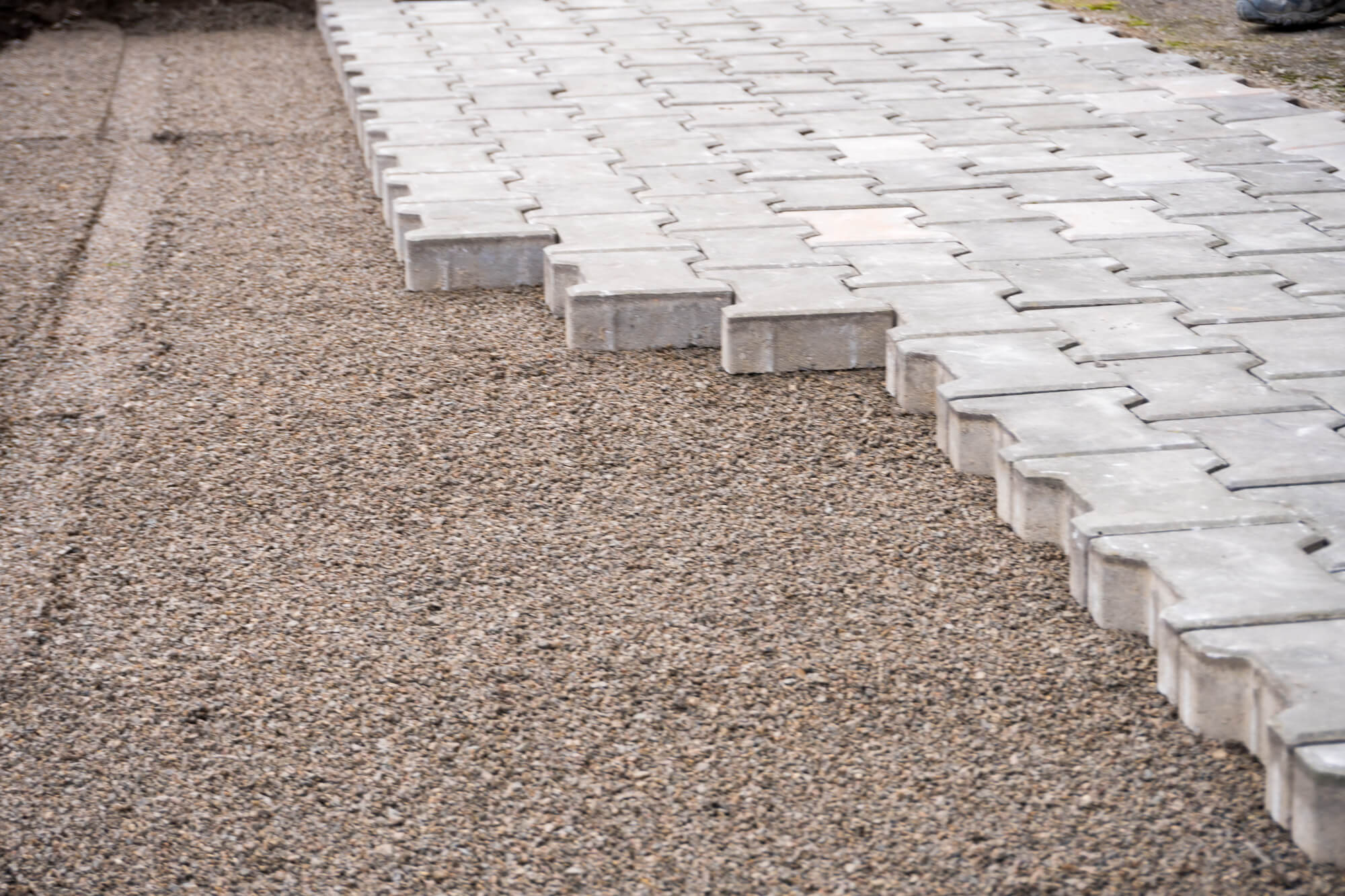
Under your outdoor pavers, there is a simple stack: units and bedding sand on top, compacted base materials (aggregate base) in the middle, and native soil underneath (the subgrade).
In cold weather, the freezing front moves down from the surface. In fine, wet soils under that base, water can be drawn up toward the cold zone and freeze into thin ice lenses that act like slow jacks.
As those ice lenses grow, they lift the base and everything on top of it. This does not happen evenly. One area may sit over clean, well-drained crushed gravel; another sits over clay soil that stays wet.
Where finer soil and water are available, more ground frost can build, and that spot may heave higher.
Federal Highway Administration guidance points to three conditions behind frost heave—frost-susceptible soil, freezing temperatures, and an available source of water—which, on a paver project, typically show up as:
- Fine, frost-susceptible soils under the base layer
- A steady water supply in the subgrade or base
- A freezing front that moves down through the section
- Uneven conditions, so some zones heave more than others
Proper pavement practice in cold climates, whether for asphalt, concrete slab, or concrete pavers, aims to remove or reduce one or more of those ingredients.
You cannot change winter, but you can change what winter has to work with under your outdoor paver projects.
Why Soil Types Matter More Than Most People Think
Whether frost heaving becomes a small seasonal “breathing” or a visible heave problem often comes down to your soil type.
Coarse, well-drained soils generally present less risk for freeze-thaw damage.
Fine-grained soils such as silts and some clays can present much greater risk for ground frost when enough moisture and freezing conditions are present.
A Quick Field Check for Frost-Susceptible Soil
On a jobsite, you do not need lab tests to get a rough read. Grab a moist handful from your excavation:
- If it feels gritty and will not hold a smooth ribbon when squeezed, it is more like sand and generally lower risk.
- If it smears, holds a shape, and stays sticky, it may contain more silt or clay and may be more likely to support frost heave.
- If you see color changes or mixed fill, assume conditions vary across the site.
When you see finer material in your trench, focus on your base preparation: deeper stone, separation fabric, or both.
On soft or disturbed subgrades, a nonwoven geotextile fabric between the soil and crushed gravel base can help keep fines from migrating into your base layer and quietly rebuilding the very layer you are trying to avoid.
Before placing the base, check the exposed subgrade for soft or yielding areas rather than simply covering them with the aggregate base. Correcting an isolated weak spot at this stage is much easier than diagnosing a recurring dip or heave after the patio is finished.
This overview is general education, not a replacement for local engineering. Local frost depth, soil maps, site conditions, and any code requirements should always guide final decisions.
Water and Drainage: Where Winter Problems Usually Start
Even on marginally acceptable soils, frost heave is much worse when water is allowed to collect under or beside the pavement. If you control where water goes before freeze-up, you take a lot of stress off the paver base system.
Walk the site during rain or snowmelt and look for simple red flags:
- Downspouts discharging directly onto or beside the pavers
- Flat landings or walkways with no clear outlet for meltwater
- Raised beds, edging, or walls that trap water along the pavement edge
If you see any of those, treat water as the primary suspect before you blame the pavers.
Often, you can gain a lot just by extending downspouts away from the paved area, cutting shallow swales to redirect water, or regrading beds so water sheds away instead of toward the edge.
Subgrade or soil compaction plays into the drainage system as well.
The goal is firm, uniform support without creating a pavement section that traps water.
On poorly draining soils, the excavation depth, grading, aggregate section, and drainage details need to work together so water has a reliable path away from the pavement.
Build the Base Like It Has to Survive 20 Winters
The base is your primary defense against winter heave.
In cold climates, it needs enough depth, the right stone, consistent compaction, and details that let water escape instead of sitting under your pavers.
For many residential paver walkways and patios, that means several inches of compacted crushed stone over a prepared subgrade, with more depth often required for driveway pavers, weak soils, and heavier loads. The exact number depends on frost depth, soil type, drainage, traffic, and project conditions, and should not be a one-size-fits-all rule.
Dense-Graded vs. Open-Graded Base
Most cold-climate projects use one of two base families:
- Dense-graded base mixes sizes plus fines. It compacts tightly and carries a load well, but the overall pavement section still needs to manage water so those fines do not remain saturated.
- Open-graded base uses mostly clean, angular stone with very few fines. It moves water efficiently, and properly designed open-graded assemblies can reduce conditions that contribute to ground frost damage. The complete pavement section, including sand bedding, jointing material, edge restraint, drainage, and outlet conditions, must work as a compatible system.
Don’t Use Bed to Fix Base Mistakes
Avoid using the bedding to compensate for uneven base prep. The sand bedding layer, or whatever material is used, should stay thin and uniform rather than being used to correct an uneven aggregate base.
Thick bedding pockets can compress differently and hold more moisture, so the base itself should establish the final grade before the pavers are installed.
On soft, silty, or filled soils, adding geotextile fabric under the base can help keep fines from migrating into the stone and recreating frost-susceptible layers.
Whatever you choose as a ground frost solution, thin lifts, proper plate-compactor passes, strong edge restraints, and a little extra attention at transitions—garage aprons, steps, and tight corners—go a long way toward keeping the pavers locked in place.
Concrete Slabs vs. Interlocking Concrete Pavers When the Base Moves
Both concrete slabs and interlocking concrete pavers can work in cold climates, but they respond differently when the supporting base shifts.
When you compare systems, it helps to think in terms of how they behave after a hard winter, not just on day one.
- A concrete slab that looks perfect the first fall can develop cracks or scaling after repeated winter exposure or movement below one portion of the slab.
- A concrete paver field may show localized movement, but the segmental system gives you more options to correct the affected area without removing the entire pavement.
Here is a simple side-by-side view:
Before the table, note that “better” depends on what you value: upfront cost, long-term appearance, ease of repair, or all three together.
| Aspect | Concrete slab | Interlocking concrete pavers |
| Response to uneven heave | May crack or move in larger sections | Small movements can spread across multiple joints |
| Typical winter issue | Cracking, spalling, scaling | Rocking units, localized low or high spots |
| Localized repair | Often requires cutting and patching | Units can often be lifted, base corrected, and re-laid |
| Best suited for | Properly prepared, well-drained applications | Applications where segmental repairability is valued |
Upfront price can favor a plain slab. Over a long service life, however, repairability can become an important advantage, and that’s where individual concrete pavers can often be removed and reused after the underlying cause of movement is corrected, avoiding the need to replace an entire paved surface.
That serviceability is one of the practical advantages of the segmental concrete systems Rochester Concrete Products manufactures; a hardscape can be maintained and repaired locally when conditions underneath need correction.
4 Ways to Stop Pavers From Heaving in Winter
Frost-heave prevention in hardscape construction comes down to controlling three things: frost-susceptible soil, available water, and the pavement section above them. You cannot remove winter from the equation, but good drainage, appropriate aggregate, uniform compaction, and site-specific base design can reduce the conditions that allow damaging differential movement to develop.
So, for practical planning, cold-region paver assemblies can be grouped into four useful approaches. Each one balances soils, water, drainage, and loads, so winter has less to work with.
Frost-Aware Dense-Graded Base
This is the familiar approach, tuned for climate. It uses a well-graded crushed stone base of appropriate depth over a prepared subgrade, a thin bedding layer of concrete sand, and solid edge restraint. It fits light-duty patios and walks on reasonably well-drained soils where you can shed water away from the edges.
Dense-Graded Base With Targeted Reinforcements
Here, the basic section stays the same, but you selectively deepen the base at known risk points, add geotextile fabric over fine or mixed soils, and give extra attention to edges and joints at entries and vehicle transitions. It can be a good fit for driveways, mixed-soil backyards, and areas that tie into slabs and steps.
Open-Graded Hybrid Base
An open-graded hybrid replaces some or all of the dense-graded base with clean, angular stone that drains quickly and contains very few fines. With compatible bedding, joint materials, drainage, and edge detailing, it can be useful in wet or confined sites where reducing prolonged water retention within the pavement section is especially important.
Fully Permeable Paver System
Permeable interlocking concrete pavement uses an open-graded aggregate structure designed to store and move water through the pavement section.
Where storm water management is part of the design, Rochester Concrete Products offers permeable paver systems, including Holland-Eco and Pacific-Eco, along with Cobble Stone for compatible permeable applications.
These pavers are only one part of the system; aggregate gradation, storage depth, subgrade conditions, drainage, and outlet design all affect how the complete pavement performs.
As a quick guide:
- Light-duty patios and walks: Frost-aware dense-graded base often works well on decent soils.
- Wet or poorly draining sites: Open-graded or permeable systems may be a better fit.
- Driveways: Require more attention to base depth, compaction, and load.
- Projects susceptible to storm water: May be strong candidates for permeable pavement assemblies.
How to Fix a Paver Area That Heaves Every Winter
If a paver area heaves every winter, a lasting fix means correcting soils, water, and base issues, not just re-leveling the surface.
Simply pulling a few units, adding sand, and dropping them back into the same weak base rarely addresses the underlying cause.
Start by mapping what is actually happening at peak heave:
- Mark the high and low spots
- Then, note where the water sits after the snow melts or a thaw
- Probe along the edge to see how thick the base really is and whether you hit solid stone or soft, fine material.
The worse the variation, the more likely you need to rebuild the section, not just the bedding.
As you dig in, a few clear triggers can point to full-depth reconstruction:
- Very thin or inconsistent base under the affected area
- Base or bedding that is saturated with fine soil or mud
- Chronic ponding against the edge, steps, or foundation
Where people walk every day, front entries, public sidewalks, and commercial plazas, chronic heaving becomes a safety concern as much as an appearance problem. In those areas, treating movement as “just cosmetic” can create unnecessary risk.
Homeowners can reasonably handle small lifts and relays over a sound base, along with simple water fixes like redirecting downspouts or cutting shallow swales.
When you see widespread base failure, soft or mixed soils, ponding near structures, or suspect utilities under the pavement, it is time to bring in a contractor who understands cold-climate base design and can rebuild the section properly.
Prevent Frost Heave Before Winter
Winter movement usually comes back to the same factors: soil, water, drainage, and base design. Get those right, and a paver patio, walkway, or driveway has a much better chance of staying flat and serviceable through years of freeze–thaw cycles.
Rochester Concrete Products brings more than a century of concrete manufacturing experience to hardscape products engineered for strength, durability, and freeze-thaw conditions. Combine those products with sound drainage, proper base preparation, and an installer who understands cold-climate construction, and you are building a hardscape system meant to perform for the long haul.
For help with product selection, cold-climate installation, or technical details, explore Rochester Concrete Products’ resources or work with an experienced RCP dealer or hardscape professional.