If you’re planning a new patio, driveway, pool deck, or walkway, the decision between concrete pavers and poured concrete goes far beyond appearance.
The real question is this:
Which surface will still perform, look right, and remain cost-efficient after 20 or 30 years of freeze/thaw cycles, weather conditions, repairs, and changing design needs?
For example, in cold-weather climates, both poured concrete slabs and interlocking pavers are exposed to the same environmental pressures: water runoff, de-icing salts, soil movement, and repeated freeze and thaw cycles. The difference lies in how each system handles stress, cracking, maintenance, and long-term repair costs.
We’ve created this guide to help you understand how slabs and pavers fare against the weather, how they tend to age over 30 years, what repairs look like in real life, and how the long‑term cost picture really plays out.
By the end, you’ll understand which option best supports your landscaping project, not just today, but decades from now.
Installation Differences: Foundation, Base, and System Design
No matter which surface you choose, what’s under it does most of the heavy lifting.
Many “paver vs concrete” debates ignore the first step in this important decision, which is the fact that the base layer is what actually decides who wins: the base and drainage.
Whether installing concrete architectural pavers or poured concrete patios, base preparation determines longevity.
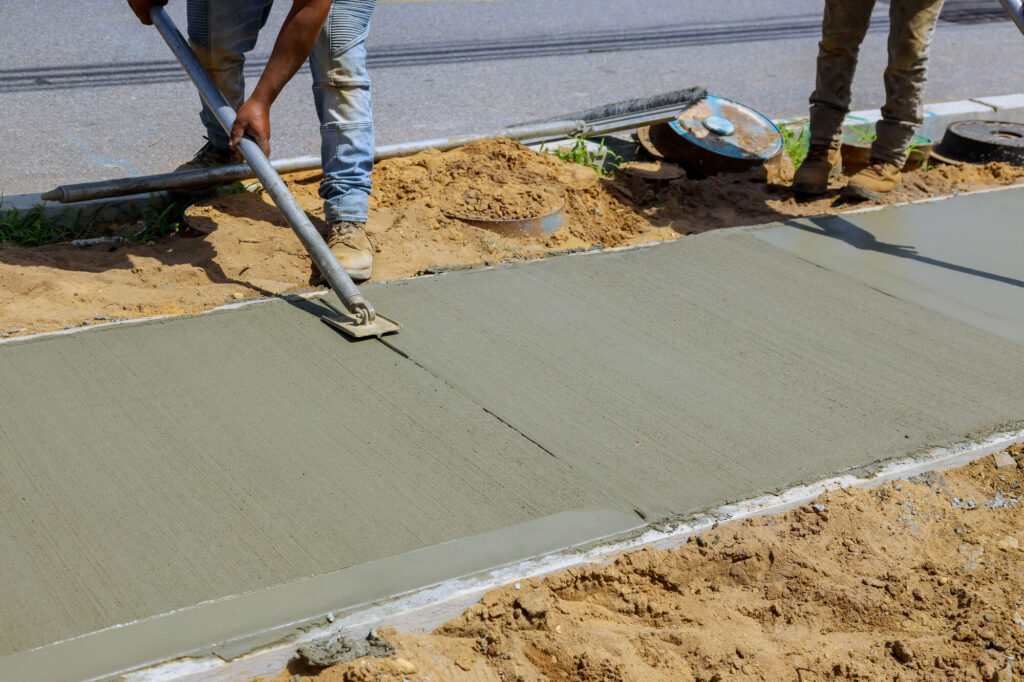
Poured Concrete Installation
A typical slab installation includes:
- Excavation
- Compacted subgrade
- Gravel or crushed stone base
- Rebar reinforcement
- Concrete pour
- Control joints
- Finishing and curing
While installation costs are often lower upfront, slab performance depends heavily on:
- Soil stability
- Proper rebar placement
- Joint spacing
- Drainage slope
If the foundation shifts or water collects beneath the slab, cracking becomes likely.
Paver Installation System
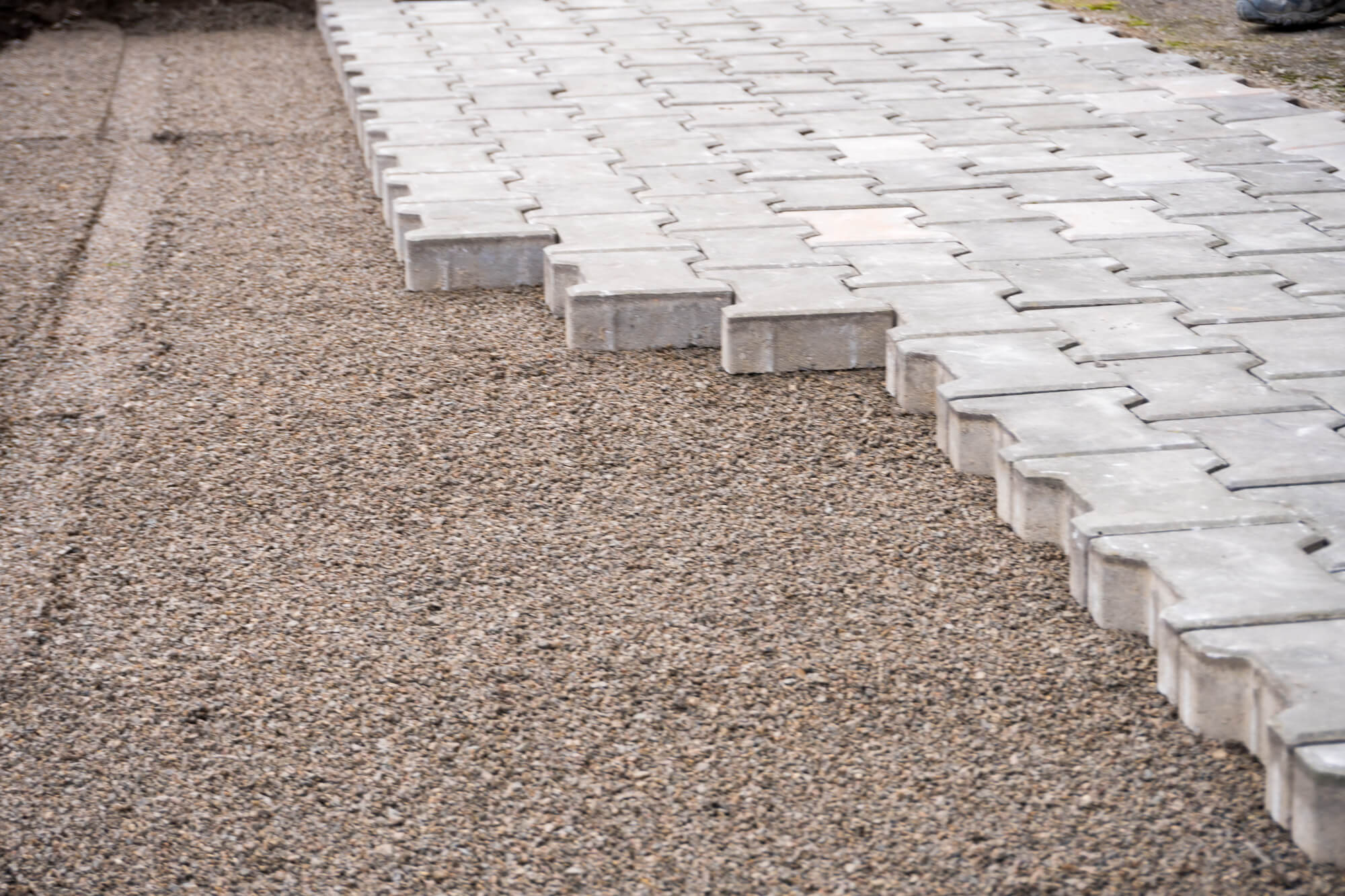
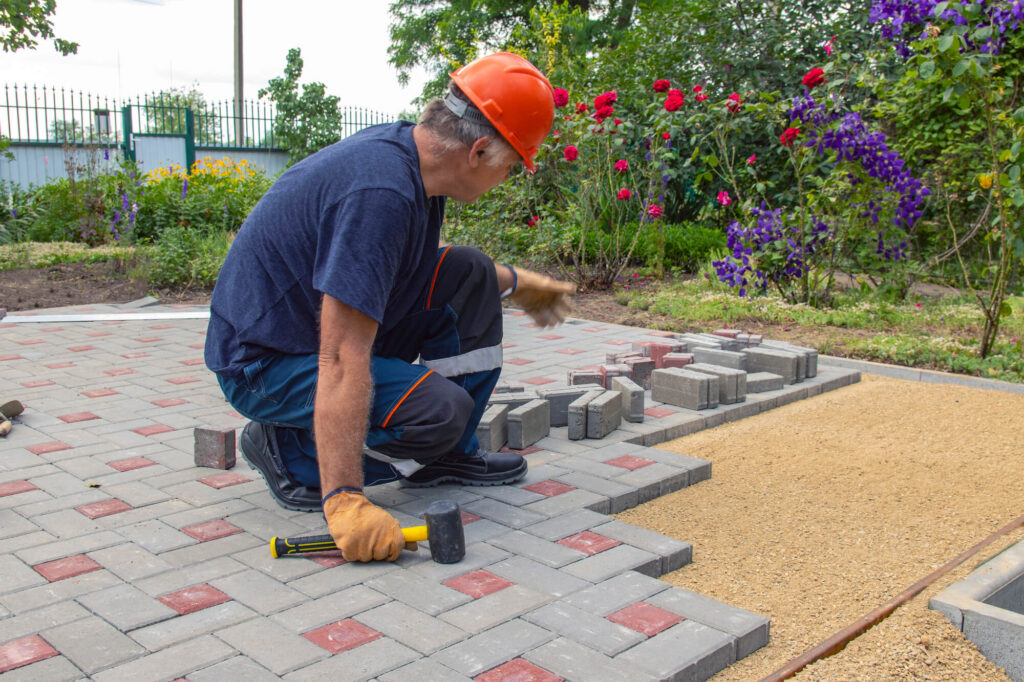
Professional paver installation follows a layered system:
- Possible excavation, but not always, and subgrade preparation
- Compacted crushed stone base (typically 6–8 inches or more)
- Bedding sand layer
- Installation patterns using interlocking pavers
- Joint sand or polymeric sand compaction
- Optional sealer application
Because the system is modular, it allows for permeability and improved water runoff control when designed properly.
The base and sand joints act together to manage stress rather than resist it rigidly.
Durability and Structural Performance Over 30 Years
The upfront price is easy to see; the 30‑year cost is not. To compare pavers and concrete fairly, you have to look at routine care, likely repairs, and when each system typically hits the point where replacement or major rebuild makes sense.
Typical Lifespan of Poured Concrete
Even with optimal installation and planning, residential applications will typically behave as follows:
- Concrete patios often show surface wear within 10–15 years
- Scaling and cracking may appear between 15–25 years
- Larger structural cracking can require replacement by year 20–30
While some slabs last longer, many experience visible cracking and cosmetic deterioration, especially under salt exposure.
Repair costs increase when panels require removal and repouring.
Typical Lifespan of Concrete Pavers
Properly installed concrete pavers commonly provide:
- 30+ years of service life
- Localized repairs instead of full replacement
- Minimal structural cracking
Even if a paver cracks or stains, individual units can be replaced without disturbing the surrounding area.
That’s why concrete pavers often prove cost-efficient over a 30-year window, particularly in climates exposed to freeze and thaw cycles.
The ability to perform localized repair rather than full replacement significantly affects lifetime ownership costs.
Repairability: Modular vs Monolithic Systems
This is where the difference becomes most noticeable over time.
Repairing Poured Concrete
When cracking or settlement occurs, repairs may involve:
- Saw-cutting damaged sections
- Removing slab portions
- Re-pouring new concrete
- Waiting for curing
- Visible patch lines
Even well-executed repairs often leave aesthetic differences in color variations and texture.
Repairing Interlocking Pavers
With paving stones:
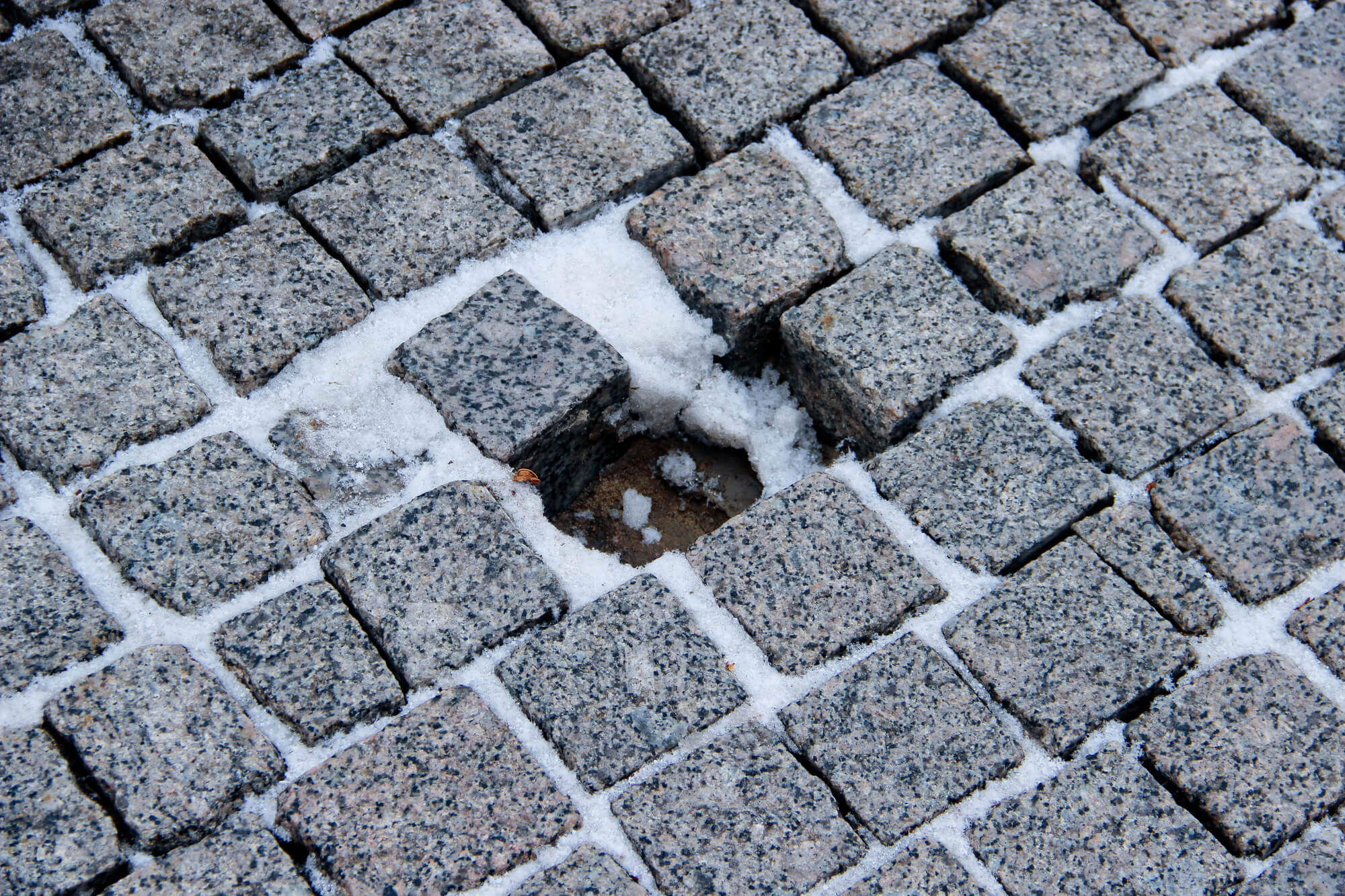
- Lift affected pavers
- Rebuild the base if necessary
- Relay original pavers
- Compact and re-sand
Downtime is minimal. Visual appearance remains consistent.
For landscaping projects involving future utility work or design changes, this flexibility is a major long-term advantage.
The Freeze–Thaw Reality Check: Why Concrete Surfaces Fail
In regions where winter temperatures fluctuate, freeze-thaw cycles are the primary stress test for any hardscape surface.
Water enters microscopic pores. It freezes. It expands. Then it thaws. Repeat that process hundreds of times, and the results become visible.
Before you compare pavers and concrete, it helps to understand that most “mystery failures” aren’t mysterious at all; they’re just the climate doing what it always does, but in this case, it’s doing it to your paving stones and poured concrete.
How Freeze–Thaw Cycles Impact Poured Concrete
A poured concrete slab is a rigid, monolithic surface reinforced with rebar and separated by control joints designed to direct cracking.
But control joints do not prevent cracking. They only attempt to manage where cracks appear.
Over time, freeze-thaw cycles can cause:
- Surface scaling and spalling
- Hairline cracks expanding into structural cracks
- Water intrusion beneath the slab
- Settlement due to base failure
- Widened cracks from rebar expansion or soil movement
When cracking occurs beyond control joints, repair options become limited and often visible.
How Interlocking Pavers Handle Freeze and Thaw
Unlike poured concrete, interlocking pavers are a flexible pavement system.
Each paver rests on:
- A compacted crushed stone base
- Bedding sand
- Joint sand or polymeric sand
Because pavers are individual units with sand joints between them, they can absorb slight ground movement without cracking.
Instead of one rigid slab resisting force, the system distributes loads across:
- The crushed stone base
- Sand joints
- The interlocking pattern
That flexibility is often why properly installed concrete pavers outperform slabs in aggressive freeze/thaw climates.
Maintenance Requirements and Long-Term Costs
Every surface requires maintenance. The question is how much and how disruptive.
Maintenance for Poured Concrete
Common maintenance tasks include:
- Crack and joint sealing
- Applying sealant or sealer
- Pressure washing
- Panel replacement when necessary
Control joints may require monitoring. Water runoff management remains important to reduce sub-slab erosion.
Over the decades, long-term costs often include patching and eventual replacement.
Maintenance for Pavers
Concrete pavers typically only require:
- Re-sanding sand joints
- Optional sealer application
- Pressure washing for cleaning
Because the system allows drainage and movement, widespread cracking is uncommon.
Some manufacturers like Rochester Concrete Products also offer warranty coverage that reflects long-term durability expectations, with select products even carrying a lifetime warranty under specific conditions.
Design Versatility and Aesthetic Performance
Beyond structural concerns, visual appearance matters.
Poured Concrete Design Options
Poured concrete offers:
- Basic broom finish
- Stamped concrete patterns
- Limited color blends
- Surface staining
However, color variations can occur during curing, and stamped concrete may fade over time and require resealing.
Control joints also interrupt the aesthetic of large concrete patios and driveways.
Paver Design Versatility
Concrete pavers offer significantly broader design options:
- Installation patterns like herringbone, running bond, basketweave
- Architectural pavers with clean edges
- Handcrafted concrete pavers with textured finishes
- Concrete pavers that mimic natural stone pavers
- Wide paver colors and color blends
Because each unit is individually manufactured, color consistency and aesthetic control are easier to maintain across large patios, pool decks, walkways, and gardens.
Design versatility is often one of the strongest reasons homeowners choose pavers.
Slip Resistance, Permeability, and Drainage
Surface performance also affects safety and comfort.
Concrete slabs can become slick when sealed. Water runoff may concentrate in certain areas if grading is imperfect.
Interlocking pavers offer:
- Natural slip resistance from textured surfaces
- Sand joints that allow slight permeability
- Improved drainage options when installed over open-graded bases
For pool deck environments or areas exposed to frequent moisture, this can influence long-term usability.
When Pavers Make the Most Sense
Interlocking pavers are often the better option when:
- Freeze-thaw cycles are severe
- Soil conditions vary
- Driveways experience heavy loads
- Future utility access is likely
- Design flexibility is important
- Long-term durability matters
For high-visibility areas like driveways, patios, and walkways, the combination of durability, repairability, and aesthetic control often justifies the initial investment.
When Poured Concrete Still Works
Poured concrete may remain practical when:
- The site drains exceptionally well
- Budget constraints are tight
- The area is small or secondary
- Visible cracking is acceptable over time
With proper base preparation, rebar placement, and drainage, slabs can perform well in certain conditions.
The key is aligning the system with the site.
Choosing the Right Surface for Your Landscaping Project
Concrete pavers and poured concrete both have their place.
But interlocking pavers consistently offer greater flexibility, repairability, and lifespan performance.
For homeowners investing in a patio, driveway, pool deck, or garden walkway, the decision should consider:
- Climate
- Soil conditions
- Design goals
- Long-term investment strategy
- Expected maintenance tolerance
When installed properly over a compacted crushed stone base with quality bedding sand and joint sand, pavers provide a resilient, adaptable surface designed to perform for decades.
Work With a Rochester Concrete Products Dealer
The most durable hardscape surfaces are built as complete systems, from foundation to finish.
An authorized Rochester Concrete Products dealer can help evaluate:
- Your soil conditions
- Drainage needs
- Appropriate installation patterns
- The right paver colors, textures, and architectural styles
- Warranty coverage and long-term maintenance planning
Whether you’re upgrading aging concrete patios or starting a new landscaping project, choosing the right system today can prevent costly repairs tomorrow.
Explore Rochester Concrete Products’ full line of concrete pavers and design solutions to build a surface that performs as beautifully as it looks, for decades to come.